For the last decade, SaaS has been the default answer to almost every internal software problem.
Need dashboards? Buy a tool.
Need workflows? Buy another.
Need reporting? Add one more license.
This made sense when software was slow and expensive to build. But that assumption is breaking.
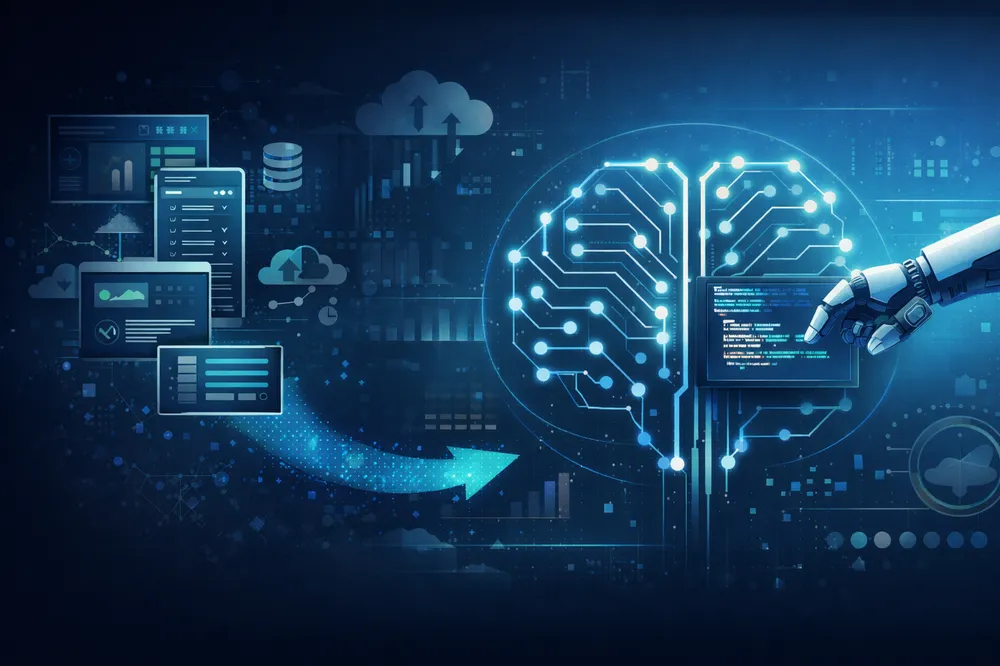
With modern AI coding agents, the cost and speed of building internal software has fundamentally changed. The real question is no longer “Can we build this ourselves?”-it’s “Can we build this safely, securely, and in a way that scales?”
That’s where most teams get stuck.
Agents are eating SaaS—but not responsibility
Agentic coding allows engineers to generate production-quality code faster than ever before. Internal dashboards, admin tools, data pipelines, workflow systems—things that once justified recurring SaaS subscriptions-can now be built in days instead of months.
But speed alone doesn’t make software good.
Internal applications still need:
- Secure authentication and access control
- Proper data isolation and compliance boundaries
- Scalable architectures that don’t collapse under real usage
- Observability, logging, and monitoring
- Clear ownership and maintainability over time
Without these, “AI-built software” quickly becomes just another fragile internal tool-fast to create, painful to run.
The real risk isn’t AI code—it’s undisciplined engineering
The biggest misconception about agentic coding is that it removes the need for experienced engineers. In reality, it does the opposite.
Agents are incredibly good at:
- Generating boilerplate
- Implementing well-defined logic
- Refactoring and extending existing systems
- Accelerating repetitive or complex changes
They are not accountable for:
- Your security posture
- Your uptime
- Your data governance
- Your future scale
Those decisions still require judgment.
The teams that succeed with agentic coding aren’t the ones prompting harder-they’re the ones applying real engineering discipline faster.
Why internal SaaS is suddenly viable again
Most SaaS tools exist to solve broadly similar problems for thousands of customers. That means tradeoffs, unused features, awkward workflows, and pricing tiers that grow faster than value.
Internal SaaS flips that model:
- One customer
- One data model
- One roadmap
- One set of constraints
When combined with agentic coding, internal tools become:
- Faster to build than integrating a third-party API
- Cheaper over time than recurring licenses
- More secure by default, living inside your infrastructure
- Easier to adapt as your business changes
The result isn’t a prototype—it’s software you actually own.
Where Incentius fits
At Incentius, we sit at the intersection of agentic speed and engineering rigor.
We use AI coding agents aggressively—but we apply them within proven software engineering practices:
- Secure-by-design architectures
- Production-grade deployments
- Scalable backend systems
- Clear documentation and operational ownership
- Codebases that can be understood, extended, and maintained long after delivery
Agents accelerate the build.
Engineering ensures it survives.
What we deliver is not “AI-generated code.”
It’s robust software, built faster than traditional teams can manage.
This isn’t about replacing all SaaS
There will always be SaaS products that make sense—payments, global infrastructure, compliance-heavy platforms, tools with massive network effects.
But large parts of the SaaS stack—especially internal dashboards, CRUD-heavy tools, reporting layers, and operational workflows—are no longer defensible by default.
Organizations with technical ambition are starting to ask better questions:
- Do we actually need this subscription?
- Could we build exactly what we need?
- Would owning this software reduce long-term risk?
Increasingly, the answer is yes.
The future belongs to teams who own their software
Agentic coding doesn’t eliminate engineering—it removes excuses.
The companies that win in this next phase won’t be the ones with the most SaaS licenses. They’ll be the ones who:
- Build software tailored to their business
- Keep it secure and scalable
- Control their own roadmap
- And move faster because they’re not waiting on vendors
That’s the future Incentius is building toward.
Agents change the speed of software.
Engineering determines whether it lasts.